
Room Acoustics for the Home Studio
How to create a great sounding studio environment in a typical room in your home
by Tweak
One
can really delve deep into
this subject and a lot of people do. Acoustics is a science. Recording is an art.
I try to keep a focus on what will help make better art. After all, I have a home
studio. I make music because it is part of my blood, not to make a platinum
record. If my room is not acoustically textbook perfect, I don't care.
But I do care, to the point of passion, on how things sound in here. And how
I feel in the space where I spend more time than anywhere else on this planet.
|
Tweak's room is a mixture of bass traps and acoustic foam |
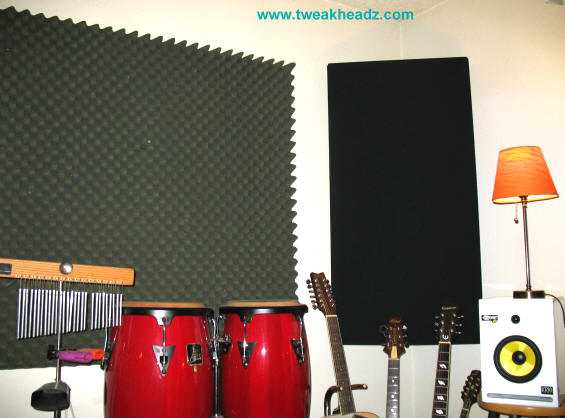
So, the critical thing, for me, is to have a good sounding room that enhances what I am doing--recording instruments, vocals, sampling and listening critically while mixing and editing. Lets not forget, listening for pleasure too. Your audio pleasure factor is a good guide. A bad room really grates on my nerves in a short period of time. My ears get tired and I get a headache. Its like eyestrain for the ears. Anyone that has ever painted the walls in an empty room knows what an extremely annoying room sounds like. As you start moving furniture back into the room it starts sounding better. For a music studio, you want to do this in a more exacting way, to make the room actually sound pleasant and friendly to the ear.
All rooms are boxes. It is good to think of them from "outside the box" to get some
control over what is happening to sound. Generally, a small room will have more
problems than a large open area as sound reflections will be magnified at the frequencies
the box. Small rooms need more treatment as sound will bounce around the room, off
the walls and ceiling many more times than a larger room. Also a square room is
more problematic than a rectangular room, as having the walls the same distance
apart can create strong "standing waves". You may have heard that in your room where
a particular bass frequency rattles the walls but others do not. If you haven't,
pull out a bass and play the scale and you'll find it.
If you have a choice between a square or rectangular room, choose the rectangular
one. If you have a choice between a big or small room, go big. Don't put speakers
in corners; corners magnify bass. In a rectangular room, I find it sounds better
to have the studio oriented where the speakers are pointed in the direction of the
wall farthest away, not to the short wall.
High and Upper Mid frequencies
For me the most irritating culprit is the one most easily
fixed. I refer to the room's "pinginess" or "flutter echoes" in the mid and
high frequencies. If you clap your hands and you hear several reflections,
you need to add material that will diffuse and trap them, stop them from bouncing
back and forth. Acoustic foam works on the high frequencies and will instantly add
relief to the ears. Get several some 4x4 panels (or 2x4, which are easier to ship),
3-4 inches thick if possible and hang them up on the walls. How much to add is to
me a matter of taste. You don't want to kill all the liveliness of the room or else
everything will sound dead and weak.
If you ever experienced a totally "dead room" such as an anechoic chamber, you know
that too much deadness is a bad thing. You can hardly hear anything unless it is
right in front of you! It can be disorienting. We need some reflections to
hear ourselves properly. When you walk in your studio, you should immediately feel
the difference your sound treatment makes in a pleasant way. If it starts feeling
like you are in the Twilight Zone, you probably added too much. So the trick is
not killing everything, but those frequencies that are exaggerated and annoying.
Some people like to preserve the liveliness of the room as it makes their instruments
or voice sound better. Others want a a more quiet, dry room. I tend
to the latter camp because i do a lot of sampling, but it is really up to what works
for you.
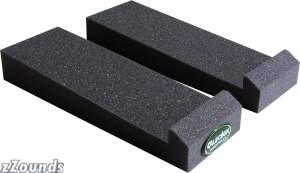
| Auralex MoPAD Isolation Pad |
| MoPADs are affordable, easy to implement, and really effective at decoupling your monitors from your room and all its contents. You've gotta get some! Until you do, you'll never know what your recordings really sound like. |
 |
For those new to the studio game lets put it out there that egg cartons don't
work. Its one of those urban legends that people repeat over and over. Ever
try to get about 300 egg cartons to stay on the walls and ceiling? I have, and it
took days. It is not an easy job. Its totally disappointing when you find out they
don't make any discernible difference at all. The icing on the cake was when they
started falling down off the ceiling at a rate of 3-4 a day at unpredictable times.
Newbies! Don't buy into the myth.
Low end and Low Mid frequencies
Professionals will tell you that controlling the lows is the top priority for treating your studio acoustically. One thing about foam, it does little to control the buildup of unwanted bass frequencies. Considering that bass traps are often control "broadband" frequencies as well as bass, one could just use several bass traps and only use a minimum of foam to correct whatever high frequency problems are left. Many pro studios use no foam at all.
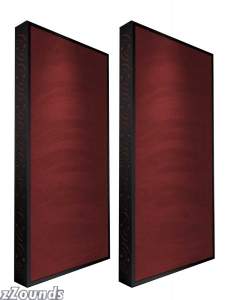
Ready Acoustics C424BG Chameleon Bass Traps (Burgundy)
Controlling the bass is important, because if the room is exaggerating certain bass frequencies, it's almost impossible to tell how much bass is actually in the mix. You move your head a foot to the left and the bass sounds heavy, move the other way it sounds weak. Too much bass energy also can mask the mid and high frequencies with mud.
The tried and true solutions are to get broadband panels which are often called bass traps made by reputable manufacturers. I'm lucky to have Ethan Winer from Realtraps.com on my forums who has educated our community on bass traps. These typically come in 2x4 foot panels and like foam, you add as many as you need. Bass tends to get reinforced in the corners of the room, so that is where treatment may be most advantageous. The corners behind your back are the first corners to treat, then the two behind the monitors. One guy on the forums made his own bass traps and built them right into the walls! Ingenious. Many make their own traps. You'll have to come by studio-central.com to see the pics.
Ok, I can hear some of you "But Tweak I want my bass, all of it! Why should I try to make it sound weaker?" Here's why. We want to hear the bass, not the room, and once to room fills up with bass frequencies, its hard to hear what you have. As one adds broad band acoustical treatment you'll hear the bass and kick drum get more defined and distinct. As you record instruments, there will be less unwanted bass in the recording. Remember the tip from another page: Bass Kills.
Tips on miking up instruments in a crappy sounding room
My first advice is to fix the room. But if you can't, you might try using a quality dynamic mic rather than a condenser. Most dynamic mics are less sensitive to reflected sound. Condenser mics, however, can be extremely sensitive and can pick up every little sound in the room, including the birds, crickets and distant trains outside your house if you crank the gain enough. The Sennheiser MD421 and ElectroVoice RE20 are great mics, so is the Shure Sm57, given that you have a quality preamp to drive the signal. You can also setup a vocal booth, or use devices like the SE Electronics Reflexion Filter and the Mic Thing Microphone Isolator by SM audio.
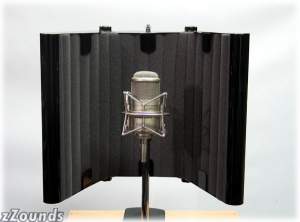
| SM Pro Audio The Mic Thing Microphone Isolator |
| The Mic Thing is a portable multi-purpose acoustic treatment panel suitable for minimizing room artifacts and improving separation during microphone recording sessions. Great for a range of applications including helping to control room ambience, minimizing spill from instrument amplifiers, or even creating temporary control rooms the Mic Thing is certainly one handy thing! |
 |
Summing it all
Ok! I have given you some hard earned tips on setting up your recording space. Now go ahead and get going. Fix those nasties! Remember that foam alone is not the solution, it really only deals with the higher frequencies. Then enjoy your room and all it can do for you. Ah the sweet silence of a quiet studio. Makes me wax poetic. Lets quote Gandhi...
Cool Quote:In the attitude of silence the soul finds the path in a clearer light, and what is elusive and deceptive resolves itself into crystal clearness. Our life is a long and arduous quest after Truth.
Mahatma Gandhi |
<insert OM sample>
Aight! Hope you enjoyed that bit of peace. Now we are going to war, but not one that kills people, thankfully, but a war that can kill your studio as soon as you turn on the power. Yes, studio fiends, next up is the "War on Hum".
Give Feedback on this article here:
http://studio-central.com/phpbb/viewtopic.php?p=284624#284624
Threads:
- Assorted acoustics and treatment Q's
- Mineral wool (does it do the job)-
- Need help on treatment for room (with room plan available)
- Owens Corning v.s Mineral Wool
- How to properly treat a Square room
- Acoustic Sealant
- The house hunt & studio space, thoughts requested.
- Is room treatment really necessary
- Need help - Classical vs Modern music room acoustics problem
- Bedroom studio acoustics ...
- DIY Soundproofing for Monetarily Challenged! [True Story!]
- Studio setup in the attic.
- Movable room dividers
- monitor placement- how far from walls and corners-
Links:
- Ethan Winer's RealTraps www.realtraps.com
- John Sayers Productions www.johnlsayers.com/
- www.GIKAcoustics.com Visit our Acoustics FAQ Page
Go to the Next Class

Go to the Previous Class
Tweak's Articles on Essential Studio Concepts