
page 1
2
MIDI Drum Traps 'n Tips
How to make your Drum tracks Come Alive
by the TweakMeister
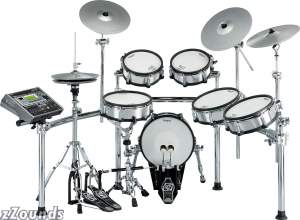
Roland
TD20SX V-Pro Electronic Drum Set
More:
Electronic Drum Sets
Problems
Its been long said that to get authentic sounding drum tracks in your midi compositions you have to "think like a drummer". This is not as easy as it might seem. Go listen to some midifiles that are out there, where the composer can't hide behind audio drum loops. The art of midi drumming is becoming a bit of a lost art. But for the really true professional doing mainstream, rock, top 40, country, i.e., all the stuff that makes money, drum loops simply will not cut it. And bringing in a drummer and miking the kit--hours down the drain, often leaves no option but to do MIDI drums. It is possible to get authentic, live sounding drum tracks from a keyboard, sound module or drum machine that may fool the ear into thinking you have a real drummer. But to get it, you need to really know drums like a drummer does. And interestingly, many of the techniques drummers use to get their signature sound are things that are difficult or at minimum time consuming to do with midi sequencers. Here's a short list of drum accents:
Cymbal chokes, flams inside of rolls, playing light "ghost hits", playing cymbals with soft mallets, rim shot in the middle of a roll, exploiting the timbral variety of a drum by going from soft to hard hits, tapping back and forth from the center of a cymbal to its periphery, playing the snare slightly ahead or slightly behind beats 2 and 4 often differently for each bar, playing with brushes on toms and cymbals, double hitting a drum with two sticks, one slightly behind providing a "snap". That's the short list. And the important thing about good drummers is that they they don't repeat these accents all the time. They put them in whenever they think they can get away with it, not only at the fill.
Example of a Tweaked drum pattern (mp3 128 k)
Solutions
Dynamics:
The drum is an intensely dynamic instrument. Even with the very best midi multilayered drum module, it will not come close to the natural dynamics of a real kit. The solution to this is to have several keymaps of the same kit, one played soft, medium and loud. You can switch between them at different points of the song. This is often a better answer than using a typical velocity switched kit
Velocity editing:
Most good modules and drum machines have velocity routed not only to volume, but to a low pass filter. This makes the hard hit brighter as well as louder. The trick here is to go into the event editor of your sequencer and make sure every hit has its own unique velocity number. If you must use looped patterns in your sequence, make sure you do this before you hit the loop command. This is extremely important on cymbals as real cymbals never sound the same twice.
Offsets to the Snare.
The drum pattern gets it's feel from a number of factors. The feel might be described as "uptight" "tight", "in the pocket", "laid back" "loose"--there are many more ways to describe them. Much of what gives the pattern feel is the position of the snare relative to the center of beats 2 and 4. For a tight, near jazz feel go into your event editor and select all the snares and move them a few midi ticks ahead. Do it while you are playing the pattern to you can instantly hear the result. For a ballad feel, usually a tad behind the pocket, move the snares the other way. The groove will relax.
Stop the Hi Hat machine
Whenever there is a drum fill and only use a pedal hat. This is what happens with a drummer if he needs his sticks to go somewhere else. One thing drummers do not do, ever, is to play the same hi-hat pattern from the beginning to the end of a song without stopping. So why did you loop the same hi hat track throughout your composition? They also don't use the same tom roll every 8 bars.
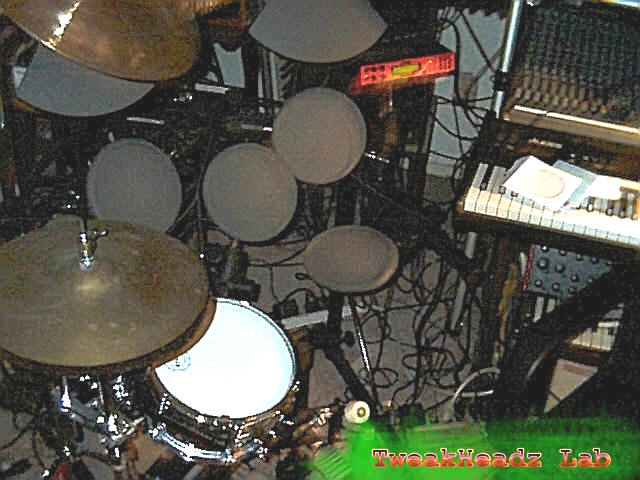
Tweak's Electronic Drum Kit is a Yamaha DTXpress and acoustic snare and cymbals
Limit yourself:
Drummers, by nature, have only two hands and two feet. This means at any given moment in time, there should be no more than 4 notes sounding. Drummers instinctively know this and if they are going to get a great drum sound they have to do things with these 4 hits to make them really stand out. Drummers don't have 64 different percussion instruments they can play simultaneously. With MIDI, you are rather unlimited. This is a problem that leads many a midiphile astray! Its a great idea to impose limits on yourself so every song does not sound "over drummed" If you force yourself to think this way, you will appreciate what drummers do with a trap kit of 10 basic sounds and 4 notes.
Quantize on!
You've probably heard that to get "natural" sounding tracks you need to turn quantize functions off and keep them off. Don't buy it! Let the Tweak correct the record here. Very few of us have the ability to lay down a consistent drum groove on a keyboard without some form of correction. The trick is to fully use quantize tools to the max to get the authentic drum sound. What you should try to avoid is quantizing the entire drum track. Instead, select only individual drum lines and quantize them. For instance, quantize all the kiks and perhaps all the closed hi hats, but leave the rest unquantized. Then go back and see where your snares are. Quantize some of them, but manually adjust others to be ahead and behind the beat and add flams on certain hits. Your sequencer has a "groove quantize" function. This allows you to consistently add offsets to 8th, 12th and 16th notes. Perfect for tweaking the kik and hats. However after quantizing your work is not done. Now you go back and manually add the accents, leading notes, the flams, the soft notes, fix the rolls and change velocities on any hits that sound the same. Do the crash cymbals last and experiments with sliding it ahead and behind the downbeat. Sliding it ahead a few ticks often adds incredible excitement to a climax, and moving it behind makes it sound like a royally expected crash.
Use Alternate Drum Controllers:
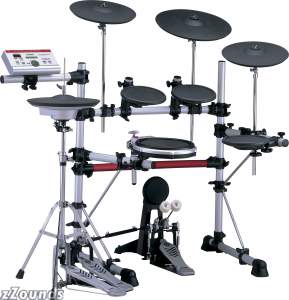
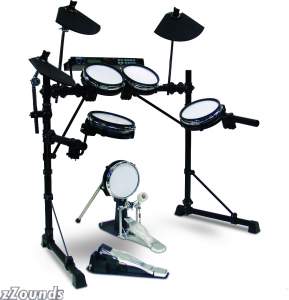
I just got a Yamaha DTxpress midi drum kit and it has really changed the way I think about drumming forever. There's allot of different options these days and those really serious about make great drum tracks might consider them It's a lot easier to think like a drummer when you are one! One of the big advantages of A MIDI trap kit is that you have to play it like a drummer--you get to feel the rush of bashing to the song, kicking it in the butt to make it move, playing harder when the break approaches, slamming the cymbals exactly when needed. And the really cool thing about these controllers is that, unlike real drums, you can play them all night long at a reduced volume or with headphones, and that you don't really have to be a great drummer to immediately dig the benefits. Put your sequencer in loop recording mode and just do the kicks, the snares then hats, etc. Then quantize away all your errors. There will still be enough uniqueness left over to have a living and breathing drum track at the end.
Threads
- Recording electronic drums and quantizing them
- electronic drum kit recording setup(midi) how?? help!!!!!!
- Tips for a better Sound from Sampled Cymbals
- electronic drums
- Getting a Big Classic Rock Snare
- Cool Stuff at zZounds: Propellerheads
- drum software for Jazz drums
- A single drum pad, that sends MIDI data
- New Roland HandSonic 10
- Roland Kit and BFD
- I need connection help VS880/VDrums/sequencer
- Silent Drums
- V-drums for recording
- Mixing down Roland V drums
Happy Drumming!
Rich the TweakMeister
Go to the Next Class

Go to the Previous Class
Go to Page 2 How to write Original Drum Tracks Fast and Furious in a MIDI Sequencer
Go to Page 3 Tweak's Cymbal Page
Drum Lessons
|
Cool Quote: "Percussion music is revolution. Sound and rhythm have too long been submissive to the restrictions of nineteenth century music. Today we are fighting for their emancipation. Tomorrow, with electronic music in our ears, we will hear freedom" John Cage Silence (original quote1939) |
More Articles on Recording and Composition by Tweak