Who needs a MIDI synth module?
In a World of Software, the Hardware Synth Module Fights Back
by Rich the Tweak
| Modules at zZounds |
How MIDI Sound Modules Evolved
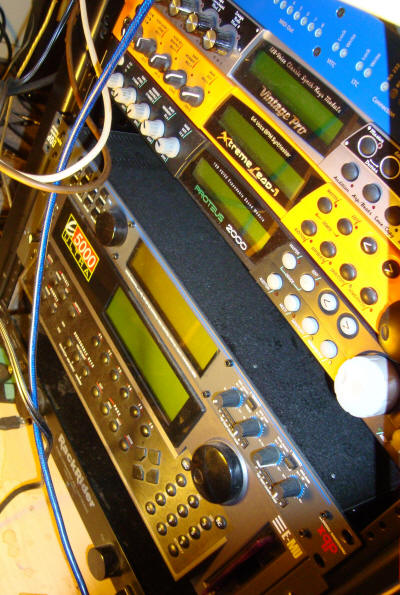
To really appreciate what a
synth module is I have to take you back to the beginning, So don your time travel suit and lets go back, back, back,
back to 1986. Every studio making money has a Yamaha DX7, a revolutionary all-digital synth
whose realism led many to sell off their old dirty analog
beasts for the clean, 80's, digital sound. But the DX7
only boasted a 32 presets and sent and received on ONE midi channel. No multi-timbrality yet. If you wanted 16 instruments to play at once, you
either tracked it to tape or needed, yep, 16 keyboards. Naturally, no one wanted 16 sets of plastic ivories in their studio so the logical answer to this was a box that contained a full synthesizer that could connect to the midi thru and give you another channel of synthesizer goodness.
Enter the first MIDI module.
The TX7 was born, a wedge shaped little nightmare with 12 buttons and a tiny display, that had all the innards of the famous DX7. It stacked right on top of the DX7 and gave you 32 more voices on channel 2. Tweaking types bought them in sufficient number. Yamaha smiled and within months we were at the next stage of module evolution, the Yamaha TX81Z, an 8 voice multi-timbral module which was like having 8 mono 4-op DX9s (the DX7's little brother) in one single rack space. The idea of getting 8 instruments playing at once for about $475 street really was a significant crossroad in the new MIDI home recording industry, and within weeks it seemed there were midi modules everywhere.
In 1988 the Roland D-110 revolutionized the game again, with Drum Kits and (gasp) a complete orchestral sound set in addition to pianos, EPs, fake guitars, and tweezy synths. Dude, it was mind blowing! I think I paid about $1100 for that. By 1989, with the introduction of the 1st Proteus by E-mu, 16 bit modules had come of age with full 16 channel multi-timbral operation and the 19" rack format, which was previously the domain of digital delays, eqs, compressors and amps became the footprint of choice for the synthesizer module as well.
The 90's were the decade of the synth module. There were analog, FM, wavetable, LA and sample playback, at nearly every price point from $300 to $3000. These have largely been made obsolete by the incredible variety of software synthesizers out there. But today's module makers are fighting back by finding ways to offer value that soft synths cannot. We'll get to that point again.
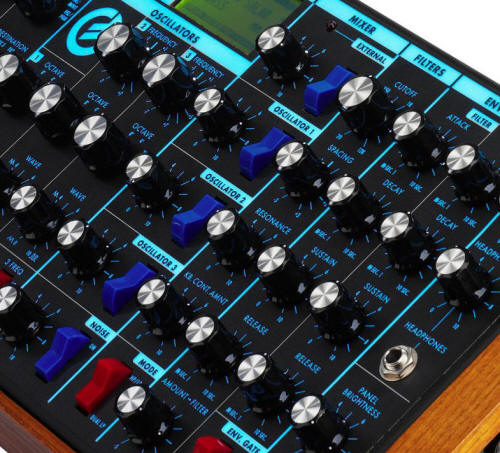
| Moog Music Minimoog Voyager Rack Mount Analog Synth Tweak: Unlike software moog versions you get Real analog synthesis here, just like old days. Yet it has MIDI, a display, can save your patches and has great build quality. |
Today's Modules
After 2 decades, the synth module is still with us. In some cases, it almost looks the same. You get a 19" rack box, a display, a few buttons, maybe a few knobs. Lets just compare a standard module from today, a a Fantom XR, to the 1st Proteii. Both modules were in the $1200-$1300 range when they came out. The Proteus /1XR (XR=extra ram) had 384 presets, no resonant filters and could add one $499 expansion board that increased the sample rom from 4 megs to 8 megs. The Fantom XR comes with 128 megs of rom standard and you can add 384 megs via 6 SRX expansion boards and a half GB of your own samples. Compared to a Maxed out Proteus XR with 512 presets, the Fantom XR takes you the 3-4,000 range, depending which boards you have installed. That's a huge sound palette! The Fantom feature set includes resonant filters and more modulation and effects options than many of us will be able to explore.
|
It should be clear what the major advantage of the synth module is: You get the full features of the keyboard version (sometimes more, sometimes less) in a nice convenient package that fits in a studio rack and takes up little studio real estate. There has been many a classic midi synth module that is still in demand today. As you might expect, the early analog synth modules still get premium dollars at online actions. I am referring here to the Oberheim Matrix 12, 6r, 1000, the Roland MKS-70 and 80 as some early notables. There plenty of classic modules still working in today's studios like the Roland D550, the Yamaha TX802, TG77, the Korg Wavestation A/D and SR. These are still in demand because they sound great.
Today's MIDI modules are a result of 2 decades of refinements. They totally overpower the modules of the past with memory, voices, dynamic range, signal to noise and just about any spec you want to toss at it. The display has changed from a 16 character non backlit LCD to a large graphic display in some cases,
even touch-sensitive, in the case of the recent V-Synth XT
and Korg M3M. Modules that support 128 voices and sampling and rom expansion options line up the higher end. While in the
80's and 90's you definitely needed 4-6 modules to make a full MIDI production, today you really only need one to
do a full piece of music.
Types of Modules Available
Massive Sound Palette Modules. Perhaps the most attractive of the modules, these offer a truly large set of sounds with expansion options to cover nearly every musical need. The Roland Fantom XR, Korg M3M and Motif Rack all fit in here. These also include the Roland 1080, 2080, 3080, 5050, and the Triton Rack (especially if expanded). These may or may not have general MIDI capabilities, so make sure you check. The P2000 does not, for example. The Roland's' do have GM. After all, they pretty much invented it when they released the Roland D110 module back in 1988. The Korg Wavestation SR had 511 presets. The Korg M1R was considered a massive sound palette in its day. Emu made a play for the massive module with the Ultra Proteus and the Proteus 2500. Today's Fantom XR has the capacity for a larger library than any module ever made, I think. The Motif ES Rack will be replaced by the XS rack soon. I recommend picking up an ES rack and filling the 2 PLG slots with expansion cards (like the analog and FM synthesis cards). Those slots will disappear on the XS rack, I predict. Yet the crown has to go to the Korg M3M right now.
Super Tweak Machine Modules: Here we have the big boys like the Roland V-Synth XT and the Korg M3M (especially when you add the Radias card) which both offer features you won't find on common synths, hardware or software. Vocoding and the kind of pitch and time based synthesis of these synths would take a lot of computer horsepower if you did it in software. Here, we see the module makers fighting back. It will be quite sometime before a soft synth can do what a V Synth XT can do. And there are some of us that don't want to tweak knobs with a mouse no matter what. High end synthesis is back, and this time its in the form of the synth module.
Specialty Modules: These are modules that cater to a specific class of music and do that class extremely well. The big names here are Novation, Waldorf, Access Virus and more on the higher end. One the lower end are the groove boxes by Korg, such as the Electribe series. The middle is increasing getting populated with big modules like the Korg Radias, derived from Korg's earlier MS2000R.
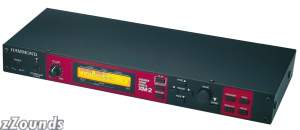
You will find there are two different product formats for specialty modules. The Most common is the 19" rack module. Many of the newer "DJ" style modules that lay flat on a desktop are often called "desktop modules". Some desktop modules can be rack mounted and some cannot. Specialty modules usually do not have General MIDI.
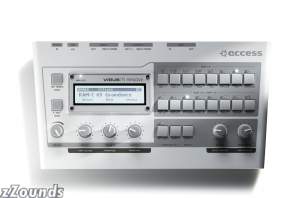
Tweak: Desktop modules are making a comeback in 2008 with the Virus Snow, Roland Sonic Cell, and the Waldorf Blofeld. The Blofeld and Snow are specialty modules. Rather than do everything, these go after a specific type of sound and do it well.
There's a ton of discontinued specialty modules like those from Emu. There was the Pure Phatt and Planet Phatt (hip hop) Orbit, Orbit V2 and Orbit3 (trance/techno) the Planet Earth, Carnaval (world) Morpheus (tweaker's delight) and others both in the rack and desktop module format. (The MP-7, XL-7 and PX-7). I was sorry to see them go! But today you can get an Emulator X2 soft sampler and buy these sound sets to bring them back to life. Perhaps it is a sign of the time that Cakewalk's SoftSynth, Dimension Pro, now sells the old emu sample sets, like the hip hop 'Mo Phatt set, which I think was one of Emu's best. These sets are designed to faithfully emulate these older modules. Guess that makes all my old modules classics!
Take a look at the Access Virus TI2 below. It's tempting to put it in the class with the super tweak machine modules, but at it's heart it is after doing one thing--faithfully emulating analog synthesis--and that it does extremely well. Also for analog, don't forget to check out the Moog Voyager.
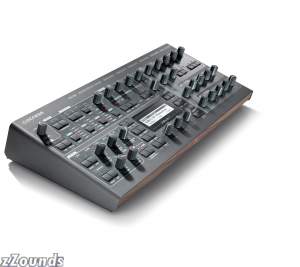
General Modules: These are modules designed for the those needing a wide range of sounds, general midi capability and other basics that the user may need for gigs and for studio use. This group includes the Kurzweil PC2r, the Roland XV2020, the Roland Sound Canvas, Yamaha MU50 and others. These modules have all the "standard" sounds like pianos, strings, clavs, horns that you expect. They usually have General MIDI compatibility. The latest incarnation of the general module is the Roland Sonic Cell.
Micro Modules: These are small boxes that usually specialize in one class of instrument and do it well. Examples here are the Kurzweil Micropiano, Alesis NanoBass on the low end and the Yamaha VL70M physical modeling synth on the higher end.
These seem to be disappearing.
The Best Module for your Studio
The answer really depends on what else you have in your arsenal. Putting together a complete recording studio involves taking stock in what you already have and filling the gaps of what you don't have. If you already have a general MIDI soundset on your keyboard, do you really need a general module that covers the same territory? Not really, unless the module does it significantly better. Yet if you only have a general soundset on your keyboard, and you want to do advanced DnB and techno, it makes a lot of sense to get a specialty module that has the analog style sounds you want, ready to roll.
If you already use a soft sampler, does it make sense to get a module with another sampler? It might! If the synth uses the samples as its sound sources you might want to load some custom samples into it. If you already have a keyboard you like, but it's older or not very powerful with sounds, then you might want to look at some of the workstation like modules like the Korg M3M or a Fantom XR. Variety is the true spice. If you already have 2 Emu modules should you get a third or should you get something different, like a Motif Rack? Go Motif. Synths which use the same engine, though they are based on different sound sets, often have a similar "ring" in the mix. Experienced tweaks can spot an Emu vs. a Roland vs. a Triton in the mix regardless of which model you have. The difference in sound engines is much like the difference between two personalities. Forget brand loyalty. Mix and Match. You will sound better for it.
Go to the Next Class

Go to the Previous Class
|
Want to talk about MIDI Modules? See what's hot! |
Great Links
VintageSynth.com Look up nearly any synth module ever made.
Cool Quote:
Have you ever been up in your plane at night, alone, somewhere, 20,000 feet above the ocean?... Did you ever hear music up there?... It’s the music a man’s spirit sings to his heart, when the earth’s far away and there isn’t any more fear.
Dalton Trumbo (1905–1976), U.S. screenwriter
More Articles by Tweak on Keyboards and Synths
Forums on Synthesizers